The regions · Chile
Colchagua: the Carmenère valley (and much more)
Colchagua is a valley south of Santiago that became synonymous with Chilean red. More than a third of all the Carmenère planted in Chile is there, the grape the country adopted as its own. And there's a surprise: near the sea, the same valley makes fresh whites.
Where it is and what the place is like
Colchagua is about 180 km south of Santiago, in the southern half of the Rapel Valley. It runs from the foot of the Andes to the coast, and it's big: in 2022, it had about 30,000 hectares of wine grapes, almost a quarter of all of Chile, according to SAG, the Chilean government's agricultural service.
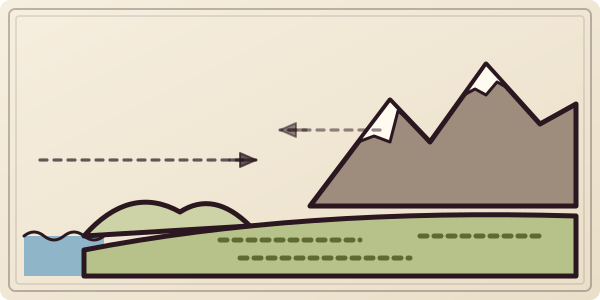
The climate is Mediterranean. The trick is in the coastal hills: since they're low, they let the Pacific breeze in to meet the wind from the Andes. That cools the valley and stretches out the ripening, which helps the grapes hold on to acidity, that freshness that makes your mouth water.
The region's grapes
Carmenère gets the fame, but the most planted grape is Cabernet Sauvignon: almost 40% of the vineyards in 2022. Carmenère comes second, with 12%, and Merlot right behind, with 10%. Then comes a smaller group, with Syrah, Chardonnay, Sauvignon Blanc and Malbec.
Even though it's second at home, Colchagua is Carmenère's great stronghold: in 2022 it had more than a third of all the Carmenère in the country. On the coast, the list turns upside down: in Paredones, almost half the vineyards are Sauvignon Blanc.
What wine comes from there
The vast majority is red. Wines of Chile, the producers' association, talks about reds with good color, freshness and good aging potential, meaning they hold up for a few years in the bottle. Many are blends, a mix of grapes.
Carmenère has a face of its own: very dark color, black fruit, a touch of black pepper and soft tannin. If what scares you about reds is that grip in your mouth, it's a good way in.
On the sea side, the newer plantings make cool-climate whites, with more acidity. In Paredones there's also Pinot Noir, a red grape that likes the cold.
What the label says
On the label you may see three layers, from biggest to smallest: Valle Central (the region), Valle del Rapel (the subregion) and Valle de Colchagua (the zone). All of them count as a denomination of origin, the DO, under Decree 464, from 1994. The smaller the name, the more precise the address.
Within Colchagua there are also areas with their own names, like Santa Cruz, Lolol, Marchigüe, Paredones and Apalta. Apalta, a piece of Santa Cruz, only made it into the law in 2018. In any case, the rule requires at least 75% of grapes from the place written.
And the extra words? “Andes” shows up on wines from San Fernando and Chimbarongo; “Entre Cordilleras”, from the areas in the middle, like Santa Cruz and Marchigüe; “Costa”, from Paredones, Lolol, Litueche and Pumanque. To use any of them, at least 85% of the wine has to come from those areas.
Carmenère, the grape that came back
Carmenère came from France in the 19th century and nearly vanished from Europe after phylloxera, a vineyard pest. In Chile it stayed alive, hidden among the Merlot vineyards.
In 1994, the ampelographer Jean-Michel Boursiquot (an ampelographer is someone who identifies grapes by the leaf and the bunch) identified Carmenère there. In 1998, it made the official list of grapes a Chilean label can name. Wines of Chile calls it the country's signature grape.
What it pairs with
Carmenère likes churrasco with farofa, linguiça sausage, pork ribs and roasted bell pepper. Wines of Chile suggests red meat and corn dishes: think savory pamonha (corn tamale), cuscuz paulista or empadão goiano.
Coastal Sauvignon Blanc goes well with fish on the grill, casquinha de siri and salad with goat cheese. But pairing is a suggestion: the best match is the one you like.
The grapes in the labels from here
In the house's 82 labels from Colchagua, the grapes that show up most. The number is how many labels they're in.
To start with: Colchagua wines by price range
The price range the house saw at big stores in Brazil, in the month shown. The price changes; the range tends to stay.
- Montes Cabernet Sauvignon (Classic)R$ 100 to 150checked Sep 2026
- Montes Alpha Cabernet SauvignonR$ 150 to 200checked Sep 2026
Throwing a party? How many bottles to buy →
Top rated from Colchagua
Average rating from the people who drank it (X-Wines), from 1 to 5. Tap to see the wine's page.
- Clos Apaltarating ★ 4.7
- Caballo Loco Grand Cru Apaltarating ★ 4.5
- Montes Angel's Secret Carmenererating ★ 4.5
- Emiliana Gêrating ★ 4.5
- Montes Folly Syrahrating ★ 4.5
- Montes Purple Angelrating ★ 4.5
- Neyen Espiritu de Apaltarating ★ 4.5
- Casa Silva Microterroir de Los Lingues Carmenèrerating ★ 4.4
See the Colchagua labels in the search →