The regions · Chile
Central Valley: the heart of Chilean wine, between the Andes and the sea
The Central Valley is Chile's great strip of vineyards, starting north of Santiago and running down to the Maule, from the foot of the Andes to the hills of the Coastal Range. Under Chilean law, it's one of the country's wine regions, and by the house's math using the 2022 official survey, it holds about four in five hectares of Chile's wine grapes.
Where it is and what the place is like
Under Decree 464, Chile's appellations law, the Central Valley Wine Region runs from Chacabuco province, north of Santiago, to the provinces of Linares and Cauquenes, in the Maule. Within it are four subregions, from north to south: Maipo Valley, Rapel Valley, Curicó Valley and Maule Valley. Maipo and Colchagua, which lies inside Rapel, have their own pages here on the site.
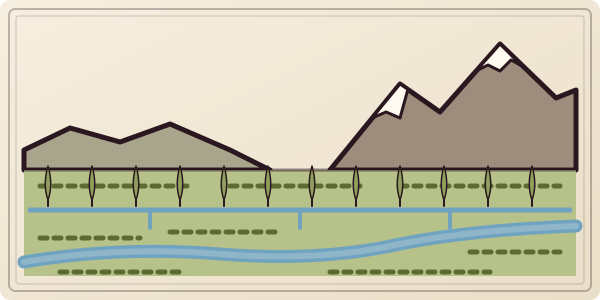
It runs from the foot of the Andes, in the east, to the hills of the Coastal Range, in the west, and the law marks out three strips: Andes (Pirque and Puente Alto, for example), Entre Cordilleras, the low middle part, which it calls the Intermediate Depression (Talca and Santa Cruz), and Costa (Lolol and Paredones). The climate is Mediterranean, with hot, dry summers and rain concentrated in winter. Curicó gets about 600 millimeters of rain a year, according to Wines of Chile, the producers' association. In the Maule, at night, a cold wind comes down from the Andes, and the sea barely reaches it.
The region's grapes
The queen here is Cabernet Sauvignon, Chile's most planted grape: almost 29% of the country's entire wine vineyard, according to the official survey by SAG, the government's agricultural service, and nearly all of it in the Central Valley regions. The same goes for Carmenère, the grape Chile adopted as its own: over 95% of it is in these lands. In Cachapoal, Carmenère, Cabernet and Merlot make up about 80% of production.
In the south of the valley, in the Maule, the old guard appears. País, a rustic, old grape, has more than half of its entire planted area in Chile there. The Maule holds some of the country's oldest vines, many of them dry-farmed. Carignan also does well in the dry lands near the Maule coast. And in Curicó, besides Cabernet, Sauvignon Blanc is among the main grapes.
What wine comes from there
Three in four hectares of Chile's wine grapes are red, and the Central Valley is red-wine country. Cabernet with dark fruit and firm tannin (that grip on your gums, like strong black tea); Carmenère with very dark color, black fruit and a touch of black pepper; softer Merlot. Many bottles are a blend, a mix of grapes.
The Maule also turns out País and Carignan from old, dry-farmed vines, where the plant lives on rain alone. And from Curicó comes fresh Sauvignon Blanc, with that acidity that makes your mouth water.
What the label says
Chilean law builds the address in layers: region, subregion, zone and area. Valle Central is the region; Valle del Maule is a subregion; Valle de Loncomilla, for example, is a zone inside the Maule; and there are smaller areas, named after towns. Any of them counts as a denomination of origin, the DO. If the label names the place, at least 75% of the wine came from there. The same 75% bar applies to the grape and the vintage year written on the label.
Since 2011, the label can carry one more word: Andes, Entre Cordilleras or Costa, which say whether the grapes grew near the mountains, in the middle of the valley or near the sea. Then the requirement goes up: 85% of the wine must come from areas with that condition. There's also a special DO, Secano Interior, just for País and Cinsault from dry-farmed areas.
And the quality words? Reserva asks only for half a degree of alcohol above the legal minimum, with wood optional; Reserva Especial, half a degree and wood; Reserva Privada, one degree, wood optional; Gran Reserva, one degree above the minimum and time in wood.
What it pairs with
Central Valley Cabernet pairs with grilled picanha, costela no bafo (slow-cooked beef ribs) and pot roast. Carmenère goes well with linguiça sausage, pork ribs, roasted bell peppers and savory pamonha (a Brazilian corn tamale). A light País, served a bit cooler, goes with roast chicken, pizza and everyday beans. Curicó Sauvignon Blanc calls for grilled fish, casquinha de siri (stuffed crab shells) and salad. All suggestions: liked another pairing? Go with that one.
A grape that came for Mass
Chile's first wine grape wasn't Cabernet. According to Wines of Chile, País arrived in the 16th century with the Spanish missions: the clergy needed wine to celebrate Mass, and a wine that would last the whole year. That's why, they say, it was the one chosen to evangelize the New World.
It spread across the dry interior that starts south of Santiago and runs to Yumbel, at the foot of the Coastal Range. Century-old vines still produce there, some over 200 years old. Rustic, it can handle a tough climate. Chilean law recognizes the names Mission and Criolla as its synonyms.
The grapes in the labels from here
Across the 795 Central Valley labels in the search, the grapes that show up most. The number is how many labels use each one.
To start with: Central Valley wines by price range
The price range the house saw at big stores in Brazil, in the month shown. The price changes; the range tends to stay.
- Concha y Toro Reservado Roséup to R$ 60checked Sep 2026
- Santa Helena Reservado Cabernet Sauvignonup to R$ 60checked Sep 2026
- Diablo Dark RedR$ 60 to 100checked Sep 2026
- Marques de Casa Concha CarmenèreR$ 150 to 200checked Sep 2026
- Terrunyo Carmenere (Peumo Vineyard Block 27)over R$ 300checked Sep 2026
Throwing a party? How many bottles to buy →
Top rated from the Central Valley
Average rating from the people who drank it (X-Wines), from 1 to 5. Tap to see the wine's page.
- Viña Vik Winery VIKrating ★ 4.6
- Lapostolle Boroborating ★ 4.6
- San Pedro Cabo de Hornos Cabernet Sauvignonrating ★ 4.6
- Casas del Bosque Private Reserve Gran Estate Selectionrating ★ 4.6
- San Pedro Altaïrrating ★ 4.5
- San Pedro Tierras Moradas Carmenèrerating ★ 4.5
- Caballo Loco Red Blendrating ★ 4.5
- Undurraga Altazorrating ★ 4.5
See the Central Valley labels in the search →
Spotted something wrong on this page?
Got it, thanks. The house checks the source and fixes it.