No-Fuss Guide · No. 15
How to open a bottle of wine without drama (and sparkling without the bang)
The waiter's corkscrew in four steps, what changes with the other openers, what to do when the cork breaks, the safe way to open with no opener at all, and sparkling wine, which comes out with a sigh. Everything sourced, no video tricks.
The waiter's corkscrew, in four steps
It's the folding pocket opener: a small blade, the spiral (the worm) and a lever with two steps. It's what sommeliers use, and it's the easiest one to master after a couple of bottles. The secret is not to rush any of the four steps.
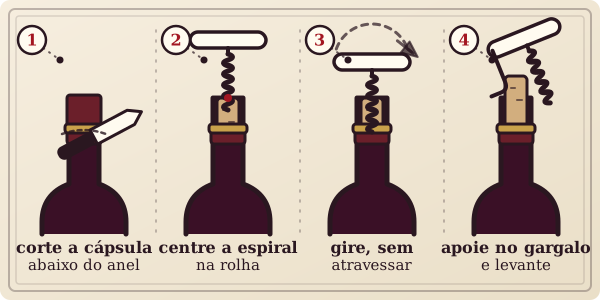
- Cut the foil below the lip. With the bottle standing still on the table, the blade runs just below the ring on the neck (the second “lip”): front, back and top. Keep your fingers away from the blade and from the edge of the foil, which cuts. The reason is practical: that way the wine doesn't run down behind the foil when you pour.
- Centre the spiral and go in straight. The tip goes in the centre of the cork (sommeliers place it a touch off-centre, so the spiral goes in straight) and you twist your way in straight, without tilting.
- Twist until one turn is left. Never go all the way through. Stop when one or two turns of the spiral are still showing, before the bottom: that way the base of the cork doesn't get pierced.
- Rest and lift, in two stages. Hook the first step of the lever on the mouth of the bottle, hold that hook in place with your other hand and lift the handle: the cork comes halfway up. Switch to the second step, lift again and finish by pulling with your hand, slowly. No pop: the sommeliers' standard is to remove the cork without a sound.
The other openers
- Winged (the butterfly): rest the base on the mouth of the bottle, centre the spiral and turn the handle: the wings rise into a V. With both hands, push the wings down and the cork comes up. It's quick. For an old or fragile cork, the waiter's gives you more control and usually has a thinner spiral.
- Plain screw (the “T”): no lever. Twist the spiral almost all the way in and pull straight up, with the bottle held firmly. It takes arm strength.
- Screw cap: hold the bottle by the base, turn the cap and the ring breaks; the skirt stays on the neck. No tool needed. The closure isn't a category: there's serious wine under screw cap.
- Synthetic cork (the smooth plastic one): same technique as the waiter's, but it's stiffer. Thin spiral, slowly, no forcing. A big lever opener can push the cork down and jam it for good.
The cork broke (or crumbled)
It happens with an old, dry cork, or when the spiral went in crooked. There's one rule: no force. The more force, the worse it gets.
- Go in at an angle. With the piece left in the neck, go in again with the spiral tilted at about 45 degrees, grab what you can and pull in one go, without twisting, with as little force as possible.
- Didn't work? Push it in and strain. Push the rest into the bottle with the handle of a spoon and serve the wine through a fine strainer, a coffee filter or a clean cloth. When pouring, the handle of a teaspoon keeps the cork away from the neck.
- Cork crumbs in the glass do no harm. And a crumbled cork doesn't mean spoiled wine: taste before you decide. A smell of wet cardboard is another story, the one about a faulty cork (TCA).
No corkscrew: what you can do reasonably safely
- A long screw and pliers (or a hammer). Drive a screw into the centre of the cork with a screwdriver until about 2.5 cm is left sticking out, grip the head with the pliers or with the claw of the hammer, as if pulling a nail, and pull straight up. It's the improvisation that comes closest to a corkscrew: no banging the bottle, no blade, and the cork comes out whole.
- Push the cork in. The handle of a wooden spoon, a screwdriver or a butter knife (the blunt side) on the cork, bottle held firmly, steady pressure, straight and slow until it drops. It will splash: do it over the sink. Then strain, as with the broken cork. The cork doesn't change the taste in the time it spends in there.
What's left out, and why. Banging the bottle in a shoe or against a wall can break the glass (and, in the test they ran, it took 10 to 15 minutes of banging). A knife, a saw or a fork in place of a corkscrew is an accident waiting to happen. Heating the neck with a lighter, don't even think about it. A piece of cork in the glass is one thing; a shard of glass is another.
Sparkling wine is another story
Inside a bottle of sparkling wine there's 5 to 6 bar of pressure, about three times the pressure in a car tyre, says the Comité Champagne. The wire cage is there so the cork doesn't come out on its own. Chilled and unshaken, the pressure stays under control: warm gas expands, and shaking raises the pressure.
- Chill first: 8 to 10 °C (that's the appellation's number; you'll find others out there). A bucket of half water, half ice, 20 to 30 minutes; or the back of the fridge for a few hours. Cold, the cork comes out gently. In a hurry, the bucket with salt does it in 15.
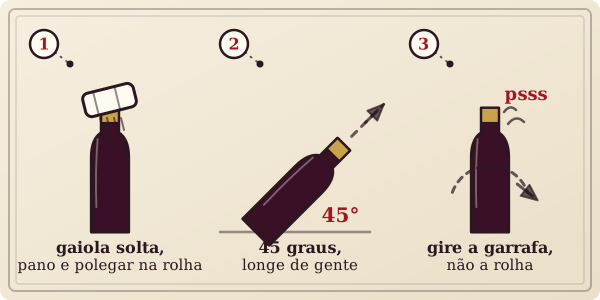
- Remove the foil, thumb on the cork, loosen the cage. Six half-turns of the wire loop. The cage can stay loose on top of the cork; what you mustn't do is take your hand off it, not even for a second.
- Cloth over the top, 45 degrees, away from people. A kitchen towel over the cork, and you hold it through the cloth. Tilt the bottle to 45 degrees, pointed away from anyone (and from glass, chandeliers, the TV).
- Turn the bottle, not the cork. Hold the cork still and turn the bottle by the base, in the air or inside the bucket, never braced against your body. The pressure keeps pushing and you hold it back: the cork comes out with a sigh, a soft “fsss”. Keep the 45 degrees for a second or two, until the gas settles: that's what keeps the foam off the table.
Why all the care: the cork flies out at more than 50 km/h, say American ophthalmologists, and the eye doesn't like it. Sabring the bottle at home, don't even think about it: even Veuve Clicquot asks you not to.