The house grapes · red
Alicante Bouschet: the grape that's red right down to the flesh
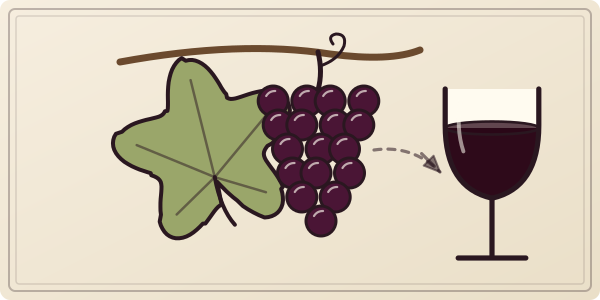
Alicante Bouschet is a rare red grape: its flesh is red too, not just the skin. That's why it's called a teinturier, a “dyer” grape, and the wine comes out almost black. It was created in France in the 19th century by crossing two grapes, and today it's the face of the Alentejo, in Portugal, where it's among the country's most planted grapes. If an Alentejo red has ever stained your glass, you can thank it.
Where it comes from
Alicante Bouschet is French and has a birth certificate. In VIVC, the international grape catalog, the official name is Alicante Henri Bouschet: a cross of Petit Bouschet and Grenache (Spain's Garnacha Tinta), made by Henri Bouschet at the Domaine de la Calmette, in France. The catalog records 1855 as the year of the cross, and DNA testing confirms both parents. In other words: it's not a grape of legend, it's a grape by design.
One of its parents was also created on purpose. Petit Bouschet was born in 1829, when Louis Bouschet crossed Aramon with Teinturier, an old teinturier grape, according to VIVC; the Lodi winegrape commission, in California, says Louis was Henri's father. A 2022 scientific study on teinturier grapes says it was from these Bouschet crosses, in the 19th century, that this kind of grape spread.
What it's like in the glass
Almost every red grape has pale flesh, and the wine's color comes only from the skin. In teinturiers, like Alicante, both skin and flesh have the red pigments, the anthocyanins, the 2022 study explains. The result: the wine comes out extremely dark. The Alentejo Regional Wine Commission, the CVRA, says the color even earned it a nickname, Tinta de Escrever (writing ink), and describes the grape as having structure, firmness, tannin (that grip on your gums) and lots of color.
On the nose, the CVRA mentions wild berries, cocoa, olive and vegetal notes. It's rarely bottled on its own: it usually goes into the blend to add color, vigor and volume, a role it plays in many Alentejo reds. When it goes solo, it makes an intense red with a bold flavor, for those who like a wine with substance. It's the same quality that made it famous in California: color that holds up even in watered-down wine.
What it pairs with
Dark, structured wine calls for hearty food: roast pork, ribs, kid goat, lamb, linguiça sausage, feijoada and carne de porco à alentejana (Alentejo-style pork), which in Brazil can become a roast pork loin with potatoes. It also takes on aged cheese, a generous cozido (a meat and vegetable stew) and pot roast. If the wine is young and unoaked, it can even handle a Sunday barbecue. All suggestions: liked another pairing? Go with that one.
Where it shines today
In Portugal, it's a star: with 8,822 hectares, it's the fifth most used grape on the mainland, with 5.3% of the area, according to the IVV, Portugal's official vine and wine institute. The CVRA says its natural home in the country has always been the Alentejo and calls it the most Portuguese foreign variety in Portugal. Even though it's French, it's so rooted in the Alentejo that the commission there treats it as one of its own.
Spain had even more in 2015: 26,000 hectares, according to the OIV, the international wine organization. In California, the official 2025 survey counted about 780 acres, around 320 hectares. In Brazil, the Campanha Gaúcha had almost 19 hectares in 2015 and authorizes it in its Indication of Provenance; and Embrapa has studied Alicante in Brazil's tropical semi-arid region, where the vine gives two harvests a year.
Its other names
In VIVC, the official name is Alicante Henri Bouschet, with 69 synonyms. On labels, the most common is Alicante Bouschet; the list also has Garnacha Tintorera or just Tintorera, and versions like Alicante Nero and Alicante Noir. Read it carefully: the catalog's list also includes names like Garnacha and Grenache Noir, which in everyday use mean Grenache, the other half of the family, and not this grape. In Portugal, the CVRA also records the nickname Tinta de Escrever, for the color.
The grape that traveled by train
In California, Alicante hit its peak in the 1920s, during Prohibition in the United States. The Lodi winegrape commission, in California, says buying wine became illegal, but each household could make up to 200 gallons a year, about 750 liters. So fresh grapes became the product: they left California by train, not always in refrigerated cars, and crossed the country to Pennsylvania Station, in New York.
Two qualities made it the favorite, according to the same commission: the thick skin, which resisted mold and rot on the trip, and the dark flesh, which gave color to homemade wine even when people added water to stretch it. Today, Lodi says, the grape is still planted there because it's still useful for giving color and firmness to red blends, and the 2025 survey counted a few hundred acres in the state.
To start with: Alicante Bouschet by price range
The price range the house saw at big stores in Brazil, in the month shown. The price changes; the range tends to stay.
- Cartuxa EA TintoR$ 60 to 100checked Sep 2026
- Cartuxa Évora Reserva Tintoover R$ 300checked Sep 2026
- Esporão Private Selection Tintoover R$ 300checked Sep 2026
- Cartuxa Évora Colheita Tintoover R$ 300checked Sep 2026
- Esporão Reserva Tintoover R$ 300checked Sep 2026
Throwing a party? How many bottles to buy →
Top rated with Alicante Bouschet
Average rating from the people who drank it (X-Wines), from 1 to 5. Tap to see the wine's page.
- Mouchão Alentejano Tonel Nº 3-4rating ★ 4.7
- Pêra Grave Pêra Velha Grande Reservarating ★ 4.6
- Quinta do Zambujeiro Zambujeirorating ★ 4.6
- Cartuxa Scala Coeli Reserva Tintorating ★ 4.5
- Dona Maria Júlio B. Bastos Alicante Bouschetrating ★ 4.5
- Esporão Torre Tintorating ★ 4.5
- Quinta do Mouro Tintorating ★ 4.5
- Reynolds Wine Growers Gloria Reynolds Art & Traditionrating ★ 4.4
See all 257 labels with Alicante Bouschet in the search →
Spotted something wrong on this page?
Got it, thanks. The house checks the source and fixes it.