The regions · Portugal
Douro: the wine born on stone steps
The Douro is the region in northern Portugal where Port wine is born and, from the same slopes, dry reds and whites that have won over the world. Demarcated in 1756, it's one of the wine regions with the oldest rules on the planet. You know that photo of a whole hillside carved into steps of vines? That's the Douro.
Where it is and what the place is like
The Douro follows the river of the same name, in northeastern Portugal, all the way to the Spanish border. The Marão and Montemuro mountains block much of the moisture from the sea: winters are cold and summers hot and dry. The local saying sums it up: nine months of winter and three of hell.
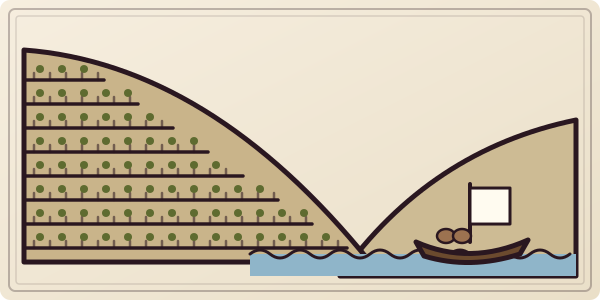
The ground is schist, a rock that breaks apart into thin sheets. To plant on such steep hills, generations of people built socalcos: terraces of earth held up by stone walls. Part of this landscape became a UNESCO World Heritage Site in 2001, under the name Alto Douro Vinhateiro (the Alto Douro Wine Region).
The whole region covers about 250,000 hectares, but only 17% of that is vineyard (about 44,000 hectares), in three subregions, from west to east: Baixo Corgo, Cima Corgo and Douro Superior. The rain fades along the way: about 1,200 mm a year in Fontes, in the west, and only 380 mm in Barca d'Alva, on the border.
The region's grapes
The IVDP, the region's official institute, authorizes 116 grapes in the Douro, but five reds made its name: Touriga Nacional, Touriga Franca, Tinta Roriz, Tinta Barroca and Tinto Cão. Touriga Franca is the most planted, with about a quarter of the vineyards. Tinta Roriz is Spain's Tempranillo. Touriga Nacional yields little, in thick-skinned berries, and makes wine with deep color and the stamina to age.
Among the whites you'll find Rabigato (the most planted white), Viosinho, Gouveio and Malvasia Fina. And almost everything is a blend, a mix of several grapes in the same wine.
What wine comes from there
Two worlds come out of the same vineyard. On one side, the dry wines: full-bodied reds with dark fruit, some to drink right away and others to keep for years; whites that are fresh or fuller, sometimes with time in a barrel; rosés and sparkling wines. On the other, Port wine, sweet and fortified. There's also Douro Moscatel and late harvest wines.
Port or DOC Douro: what's the difference?
Both come from the same grapes and slopes. The difference happens in the winery. In DOC Douro, fermentation runs all the way: the yeast turns the grape's sugar into alcohol and the wine comes out dry, like any table red.
In Port, fermentation is stopped halfway with aguardente vínica, a spirit distilled from wine. The yeast stops, some of the grape's own sugar is left over and the alcohol goes up: Port usually lands between 19% and 22%. So the sweetness comes from the fruit, which didn't finish fermenting.
What the label says
The region has two denominations of origin: Porto, for the fortified wine, and Douro, created in 1982, for wines without added spirit. On the Douro's age-worthy reds, Reserva and Grande Reserva show up a lot on the label.
In Port, the two big families are Ruby and Tawny. Ruby tries to keep the red color and the fruit of a young wine; LBV and Vintage are the top steps, and Vintage ages well in the bottle. Tawny matures in wood, turns golden brown and brings to mind chestnuts and dried fruit. It can carry its age on the label (10 years, 20 years) or the year of the vintage, in the case of Colheita.
What it pairs with
A full-bodied Douro red calls for hearty food: picanha on the grill, beef ribs, roast kid goat, the salt cod of Holy Week. The white goes well with roast fish and chicken. Tawny and pudim de leite (Brazilian flan) get along; so do guava paste and cheese. Ruby or LBV with chocolate cake or aged Canastra cheese. And white Port with tonic and ice is a summer aperitif. All suggestions: liked another pairing? Go with that one.
A name that came by boat
If it's born in the Douro, why is it called Port? Because the wine went down the river to Vila Nova de Gaia and the city of Porto, where it shipped out to the world. The IVDP finds the name vinho do Porto in a customs record from 1678.
In 1756, a royal decree, the work of Sebastião José de Carvalho e Melo (the future Marquis of Pombal), created the Companhia Geral da Agricultura das Vinhas do Alto Douro, with boundaries and rules to protect the region's wine. That's why the IVDP considers the Douro the world's first denomination of origin.
The grapes in the labels from here
Across the house's 185 Douro labels, the grapes that show up most. The number is how many labels use each one.
To start with: Douro wines by price range
The price range the house saw at big stores in Brazil, in the month shown. The price changes; the range tends to stay.
- Mateus Brancoup to R$ 60checked Sep 2026
- Porca de Murca TintoR$ 60 to 100checked Sep 2026
- Porto Ferreira Tawny PortR$ 100 to 150checked Sep 2026
- Casa Ferreirinha Papa Figos DouroR$ 150 to 200checked Sep 2026
- Taylor's Late Bottled Vintage Portover R$ 300checked Sep 2026
Throwing a party? How many bottles to buy →
Top rated from the Douro
Average rating from the people who drank it (X-Wines), from 1 to 5. Tap to see the wine's page.
- Casa Ferreirinha Barca Velha Dourorating ★ 4.8
- Casa Ferreirinha Reserva Especial Dourorating ★ 4.7
- Quinta do Vale Meão Dourorating ★ 4.7
- W. & J. Graham's Single Harvest Tawny Portrating ★ 4.7
- Quinta Nova de Nossa Senhora do Carmo Mirabilis Brancorating ★ 4.6
- Alves de Sousa Abandonadorating ★ 4.6
- Taylor's Vintage Portrating ★ 4.6
- W. & J. Graham's Vintage Portrating ★ 4.6
See the Douro labels in the search →