The regions · France
Burgundy: one grape per wine and a name for every patch of ground
Burgundy is the region in eastern France where the wine takes the name of the patch of land it came from. Red here is almost always Pinot Noir, and white, Chardonnay, each one alone in the bottle. Chablis, Meursault, Gevrey-Chambertin, Pouilly-Fuissé: all of that is Burgundy. It looks complicated, but there's just one logic, and we'll explain it.
Where it is and what the place is like
Burgundy is in the northeastern quarter of France, about two hours from Paris and one from Lyon. The vineyard is a long, narrow strip, about 230 kilometers from north to south, with 28,715 hectares in production, just 3% of France's vineyards. The climate is temperate, at the crossroads of three influences: continental, Mediterranean and oceanic. It rains about 700 millimeters a year, and summer hovers around 20 °C in July and August.
From north to south there are six areas: Chablis and the Grand Auxerrois, the Châtillonnais, the Côte de Nuits, the Côte de Beaune, the Côte Chalonnaise and the Mâconnais. In the north, in Chablis, the climate is colder and spring frost is a scare. Growers spray water on the buds: the water freezes and forms a little shell that protects them. In the south, the Mâconnais already feels like the Midi, warmer and drier, and it harvests a week before the others.
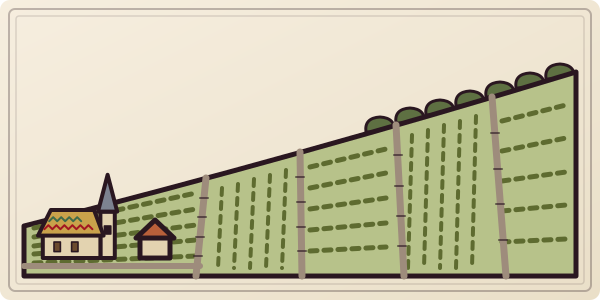
The heart is the Côte de Nuits and the Côte de Beaune: about 60 kilometers of slope along a great geological fault, between Dijon and the Maranges. In the Côte de Nuits, the strip of vines is sometimes only 200 to 300 meters wide. The vineyards sit between 200 and 500 meters of altitude, facing the morning sun.
The region's grapes
Two grapes do almost everything. Chardonnay, a white, takes up 57% of the vineyards; Pinot Noir, a red, 34%. Aligoté, another white, has 6%, and the rest (Gamay, Sauvignon, César and others) adds up to 3%. Pinot Noir has probably been there since Gallo-Roman times. And a big difference from Bordeaux: in Burgundy, the wine is almost always from a single grape. That's what lets the place show in the glass.
Each area has its own. The Côte de Nuits is Pinot Noir paradise and has most of the region's Grands Crus. In the Côte de Beaune, near the town of Beaune, Pinot Noir rules; from Meursault southward, Chardonnay takes over. In Chablis, every white is Chardonnay. In the Mâconnais, Chardonnay takes up 80% of the vines, and Gamay still shows up in the reds.
What wine comes from there
Burgundy is white wine country: about 6 in 10 wines that come out of there are white, fewer than 3 in 10 are red, and about 1 in 10 is Crémant de Bourgogne, the region's sparkling wine, white or rosé. Pinot Noir red tends to have a lighter color, delicate tannin (that grip on your gums) and aromas of red fruit. The white goes from dry, lively Chablis, with acidity (the part that makes your mouth water) way up high, to the fuller Chardonnay of the Côte de Beaune, often with time in a barrel.
In Chablis, the white ladder has its own names: Petit Chablis, light and floral; Chablis, very dry and fresh; Chablis Premier Cru; and Chablis Grand Cru, which comes from seven climats, all in the commune of Chablis. The ground there has marl, a limestone with clay, full of fossils of tiny comma-shaped oysters.
What the label says
Burgundy has 84 AOCs, the controlled designations of origin, more than 23% of all French wine AOCs. They're organized in a four-rung ladder. At the bottom, the Régionales, which apply to the whole region (Bourgogne, Coteaux Bourguignons, Crémant de Bourgogne). Then the 44 Villages, with the name of the commune, like Nuits-Saint-Georges or Meursault. Then the Premiers Crus. And at the top, the 33 Grands Crus.
The trick to reading the label: on a Premier Cru, you see the name of the commune followed by the name of the plot (Chablis Premier Cru Montée de Tonnerre, for example). On a Grand Cru, the commune disappears and only the name of the place remains, like Romanée-Saint-Vivant. That named place is the climat: a precisely marked plot, known by its name for centuries, vinified separately, with a single grape. A climat with a stone wall around it becomes a clos.
What it pairs with
A Côte de Nuits red goes well with beef any way you like: steak, pot roast, boiled beef, a stew made with wine. A simpler Pinot Noir, a regional Bourgogne, goes with roast chicken, duck, mushrooms and even salmon. The white pairs with fish and veal; a young Chablis takes on oysters, shrimp and casquinha de siri (stuffed crab shells). The fuller Chardonnay of the Côte de Beaune holds up well to chicken in cream sauce or oven-baked salt cod. And Crémant plays the role of sparkling wine for the toast and for dessert. All suggestions: liked another pairing? Go with that one.
The duke who kicked out Gamay
It was the monks who drew the map of Burgundy. The abbey of Cluny was born in 909 and that of Cîteaux in 1098, and the two orders gathered vineyard land across the whole region. Working the same plot for generations, the monks noticed that each patch made a different wine, so they separated and classified those patches, and built walls around some of them. That's where today's climats and clos come from.
In 1395, Duke Philip the Bold (Philippe le Hardi) signed an ordinance on Burgundy's grapes: he banned Gamay, which yielded a lot and made everyday wine, and kept Pinot Noir, with lower yields and more complex wine. The ordinance applied in the duchy of the time, and the Mâconnais was outside it. That's why Gamay still lives in the south today. Everywhere else, it came back little by little and only lost ground for good in 1935, with the AOCs. And since July 4, 2015, the climats of the Côte de Nuits and the Côte de Beaune, together with Dijon and Beaune, have been a UNESCO World Heritage Site.
The grapes in the labels from here
Across the 638 Burgundy labels in the search, the grapes that show up most. The number is how many labels use each one.
Top rated from Burgundy
Average rating from the people who drank it (X-Wines), from 1 to 5. Tap to see the wine's page.
- Domaine Armand Rousseau Chambertin Grand Crurating ★ 4.8
- Domaine de La Romanée-Conti La Tâche Grand Crurating ★ 4.8
- Domaine de La Romanée-Conti Richebourg Grand Crurating ★ 4.8
- Domaine de La Romanée-Conti Romanée-Saint-Vivant Grand Cru (Marey-Monge)rating ★ 4.8
- Domaine de La Romanée-Conti Romanée-Conti Grand Crurating ★ 4.8
- Domaine de La Romanée-Conti Échezeaux Grand Crurating ★ 4.7
- Domaine de La Romanée-Conti Grands-Échezeaux Grand Crurating ★ 4.7
- Domaine de La Romanée-Conti Montrachet Grand Crurating ★ 4.7
See the Burgundy labels in the search →
Spotted something wrong on this page?
Got it, thanks. The house checks the source and fixes it.