The regions · France
Rhône Valley: Syrah in the north, Grenache in the south and the wind in between
The Rhône Valley follows the Rhône River in southeastern France, from Vienne to Avignon. It's the country's second largest AOC area, according to Inter Rhône, the body that brings together the region's producers and merchants. In the north, the red is Syrah and grows on steep slopes; in the south, it's a blend led by Grenache, under sun and wind. Côtes du Rhône comes from there, and so does Châteauneuf-du-Pape.
Where it is and what the place is like
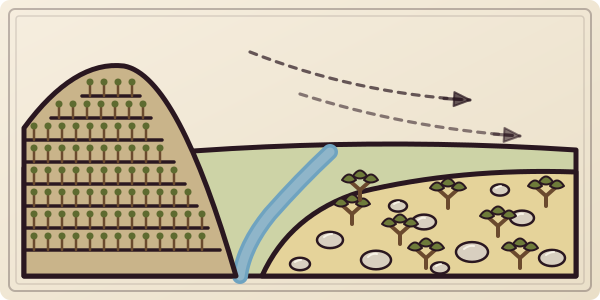
The vineyard follows the Rhône River through six departments, between Vienne and Avignon, with the Massif Central on one side, the Alps on the other and the Mediterranean down below. In practice, they're two very different places. In the north, the river runs between steep slopes, and the vines climb narrow terraces held up by dry-stone walls, on inclines that sometimes go past 60%. The ground there is granite, schist and limestone.
In the south, the valley opens into a plain, with garrigue (the low, fragrant Mediterranean scrub), lavender, olive trees and rows of cypress to hold back the wind. The one in charge is the mistral, a dry wind that comes down from the north, goes past 100 km/h and sometimes blows for days on end. After rain, it dries the grapes and helps keep the bunches healthy. The soils vary a lot: sand, marl, limestone, clay of various colors and the galets roulés, the rounded stones the river brought down from the Alps.
The region's grapes
Inter Rhône counts 37 grapes in the region, but the split is simple. In the north, Syrah reigns in the reds, and Viognier and Marsanne in the whites. In the south, Grenache makes the blend with Syrah, Mourvèdre, Carignan and Cinsault, in the reds and the rosés; the whites bring together Grenache Blanc, Clairette, Marsanne, Roussanne and Viognier. In 2025, Grenache covered 32,379 hectares of the region's AOCs, and Syrah 22,189.
The north likes a grape on its own: in Cornas, the red is Syrah only, and Condrieu and Château-Grillet make white only from Viognier. In Côte-Rôtie, Hermitage, Crozes-Hermitage and Saint-Joseph, the rules accept a single grape or a blend. The south is blend country, a mix of grapes, and that way of doing things traveled the world: abroad, Rhône blend became the name of a style. The list also moves with the climate: Marselan, for example, has already made it into some reds.
What wine comes from there
It's red wine country: in the 2025 harvest, 73% of the volume of the AOCs that Inter Rhône tracks was red, 14% rosé, 10% white and 3% sparkling, according to Inter Rhône. The northern red, from Syrah, tends to have a dark color, black fruit and a touch of pepper. The southern one, led by Grenache, is warmer and rounder, with very ripe fruit and spice. The whites range from the perfumed Viognier to the fuller-bodied Marsanne and Roussanne.
And there are the sweet ones. In Rasteau and Beaumes-de-Venise they make natural sweet wine (vin doux naturel): in the middle of fermentation, the producer adds alcohol, the yeast stops and the grape's own sugar is left in the wine. There this step is called mutage. It's called natural because the sweetness is all from the fruit, with no sugar added afterward.
What the label says
At the base is Côtes du Rhône. One step up comes Côtes du Rhône Villages, which can carry on the label one of the 21 place names the rules authorize, like Plan de Dieu, Séguret, Sablet or Visan. At the top are the crus, which in the Rhône are AOCs named after a commune: 8 in the north (Château-Grillet, Condrieu, Cornas, Côte-Rôtie, Crozes-Hermitage, Hermitage, Saint-Joseph and Saint-Péray) and 9 in the south (Beaumes-de-Venise, Châteauneuf-du-Pape, Gigondas, Laudun, Lirac, Rasteau, Tavel, Vacqueyras and Vinsobres).
Around them there are other AOCs from the same family, like Ventoux, Luberon, Costières de Nîmes and Grignan-les-Adhémar: 32 appellations in all. In Châteauneuf-du-Pape, the rules list 18 grape names, red and white, which tradition counts as 13, because Grenache, Clairette and Piquepoul come in more than one color. The producer chooses which to use and in what dose.
What it pairs with
The southern red, from Grenache, is a barbecue companion: linguiça sausage, ribs, cupim (beef hump), picanha. It also goes well with feijoada, pot roast and calabresa sausage pizza. The northern Syrah, with that touch of pepper, likes lamb, duck and grilled meat with herbs. The rosé belongs on the summer table: salad, fish, spiced food. Viognier goes with chicken curry and moqueca. And sweet Muscat takes on fruit tart and blue cheese. Inter Rhône itself sums it up: from simple grilled food to dishes with sauce. All suggestions: liked another pairing? Go with that one.
When the popes lived in Avignon
The history of wine in the Rhône begins with the Greeks, who founded Massalia, today's Marseille, about 600 years before Christ, near the mouth of the river. Later, the Romans went up the valley, founded Vienne and planted vines on terraces. In the 14th century, the popes moved to Avignon, and John XXII made the nearby village of Châteauneuf his summer home. The local wine earned the nickname the pope's wine.
The Rhône also helped invent the French rules of origin. In 1650, a regulation was already protecting the provenance of the wines of the Coste du Rhône. In the 1920s, the producers of Châteauneuf-du-Pape set up a union to defend the name, and one of them later chaired the INAO, the appellations institute, from 1947 to 1967. The AOC came out by decree on May 15, 1936, among the first in France. Since 1937, the typical bottle from there has carried, embossed, the papal tiara over the keys of Saint Peter.
The grapes in the labels from here
Across the 692 Rhône Valley labels in the search, the grapes that show up most. The number is how many labels use each one.
Top rated from the Rhône Valley
Average rating from the people who drank it (X-Wines), from 1 to 5. Tap to see the wine's page.
- Château Rayas Châteauneuf-du-Paperating ★ 4.8
- Henri Bonneau Chateauneuf-du-Pape Réserve des Célestinsrating ★ 4.7
- E. Guigal Côte-Rôtie La Moulinerating ★ 4.7
- E. Guigal Côte-Rôtie La Turquerating ★ 4.7
- Domaine Jean-Louis Chave L'Hermitagerating ★ 4.7
- E. Guigal Côte-Rôtie La Landonnerating ★ 4.7
- Pegau Cuvée Da Capo Châteauneuf-du-Paperating ★ 4.7
- Château de Beaucastel Hommage à Jacques Perrin Châteauneuf-du-Paperating ★ 4.6
See the Rhône Valley labels in the search →
Spotted something wrong on this page?
Got it, thanks. The house checks the source and fixes it.