The regions · South Africa
Stellenbosch: mountains, granite and the grape born at the university
Stellenbosch is a town and a wine region in southwestern South Africa, ringed by mountains, with a stretch that runs down to the seashore. It has made wine since the late 17th century, and it was there, at the town's university, that Pinotage was born, the grape South Africa calls its own. And more than a quarter of all the country's Cabernet Sauvignon is planted there.
Where it is and what the place is like
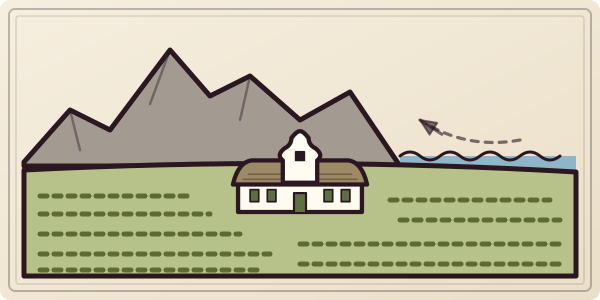
Stellenbosch is in the Western Cape, South Africa's southwestern province, and it's practically surrounded by mountains: the Helderberg, the Stellenbosch Mountain, the Jonkershoek Valley and the Simonsberg. To the south, the Helderberg subregion runs down to False Bay, a bay open to the ocean, and the vines on that side are the first to catch the cool sea breeze. The climate is Mediterranean: the rain falls mainly from May to August, which is winter there, and the summer is hot.
There's also the wind. The Cape Doctor is a southeasterly wind that blows hard in spring and summer. The nickname comes from its effect: it holds back vine diseases and lowers the temperature by a few degrees. In the ground, the star is granite. At the foot of the mountains, the rock broke down into reddish and yellowish soils, acidic, that drain rainwater well and still hold moisture for the dry months. On the Stellenbosch Mountain there are also remnants of sandstone.
The region is large and has been farmed for centuries, so it was divided into smaller pieces, the wards (small areas with more similar climate and soil). Among them are Banghoek, Bottelary, Devon Valley, Jonkershoek Valley, Papegaaiberg, Polkadraai Hills, Simonsberg-Stellenbosch and Vlottenburg. According to the survey by SAWIS, South Africa's wine statistics body, there were 11,478 hectares of wine grapes in 2025, about 13% of the whole country's vineyard area.
The region's grapes
Stellenbosch is red grape country: almost two out of every three hectares are red grapes, according to SAWIS (2025 data). The most planted, by far, is Cabernet Sauvignon, with about 20% of the area, and the town's wine route points out that the name Stellenbosch is usually linked to it. Then come Merlot, Shiraz (that's what South Africans call Syrah) and Pinotage. On its own, the region has more than a quarter of all of South Africa's Cabernet Sauvignon.
Among the whites, the most planted is Sauvignon Blanc, followed by Chenin Blanc and Chardonnay. Chenin Blanc is the most grown grape in all of South Africa and has an old nickname, Steen, which the law still allows on the label. It's a grape that's up for anything: it makes dry wine, sweet wine and sparkling wine. Pinotage, on the other hand, is homegrown: a cross of Pinot Noir and Cinsaut made in Stellenbosch, which today appears on its own or in blends.
What wine comes from there
What made Stellenbosch famous is its reds, especially the blends (wines made from more than one grape). One classic recipe comes from Bordeaux, in France: Cabernet Sauvignon with Merlot or Cabernet Franc. Cabernet is an age-worthy red: with years in the bottle, it gets fuller, more complex and picks up a touch of spice. There's also the Cape blend, the blend with a local face, in which Pinotage makes up anywhere between 30% and 70%. And Pinotage on its own, fruity, which is already tasty young and also knows how to age. Among the whites, Chenin Blanc shows why it's so versatile, from dry to sweet to sparkling, and Sauvignon Blanc rounds out the team.
What the label says
In South Africa, the origin on the label follows the Wine of Origin scheme, written into law in 1972 and put into practice in 1973. When the label carries WO next to the name of a place, like WO Stellenbosch, 100% of the grapes came from that demarcated place. The system goes from big to small: geographical unit (the Western Cape), region (the Coastal Region, which includes Stellenbosch), district (Stellenbosch) and ward, the smallest piece, like Simonsberg-Stellenbosch or Banghoek.
Two rules help you read the rest. If the label gives the name of a grape, at least 85% of the wine is from it. If it gives a year, at least 85% of the wine is from that vintage. Certification is done by an official body that since August 2023 has been called the Wine Certification Authority (formerly the Wine and Spirit Board). And if you see Cape blend, know that it's a term still taking shape, which usually means there's Pinotage in the blend.
What it pairs with
A Stellenbosch red with Cabernet calls for meat: picanha on the grill, beef ribs, cupim (beef hump), a Sunday pot roast. Pinotage, fruitier, goes well with barbecue sausage, burgers and a Saturday feijoada. Dry Chenin Blanc takes on roast chicken, fish moqueca and food with a touch of spice, like a chicken curry. Sauvignon Blanc is great with salad, grilled fish and goat cheese. All suggestions: liked another pairing? Go with that one.
The grape born at the university
In 1925, Professor Abraham Izak Perold, of Stellenbosch University, planted the seeds of a cross between Pinot Noir and Cinsaut, a grape South Africans called Hermitage. Mixing the two names gave Pinotage. In 1928, Perold changed jobs and left the little seedlings behind, on a farm called Welgevallen. The only reason they didn't end up in the trash is that a colleague rescued them during a cleanup and replanted them in Stellenbosch.
The first Pinotage wine came out in 1941, made by a lecturer at Elsenburg. Perold died that same year, without tasting it. The town has its own history too: Governor Simon van der Stel gave the name Stellenbosch to an islet in the Eerste River in 1679, and the streets were planted with oaks, hence the nickname Eikestad, city of oaks. In 1971, the country's first wine route was born there. And the local university is the only one in South Africa with a degree in viticulture and oenology.
The grapes in the labels from here
Across the 292 Stellenbosch labels in the search, the grapes that show up most. The number is how many labels use each one.
Top rated from Stellenbosch
Average rating from the people who drank it (X-Wines), from 1 to 5. Tap to see the wine's page.
- Kanonkop Black Label Pinotagerating ★ 4.7
- Beyerskloof Diesel Pinotagerating ★ 4.7
- Waterford Estate The Jemrating ★ 4.7
- Rust En Vrede 1694 Classification Redrating ★ 4.6
- Hartenberg Gravel Hillrating ★ 4.6
- Spier Frans K. Smitrating ★ 4.6
- Raats MR de Compostella Mvemverating ★ 4.5
- De Toren Fusion Vrating ★ 4.5
See the Stellenbosch labels in the search →
Spotted something wrong on this page?
Got it, thanks. The house checks the source and fixes it.