The regions · Italy
Sicily: Nero d'Avola, the volcano's wine and Marsala
Sicily is the largest island in the Mediterranean, at the toe of the Italian boot, and it has made wine since before the Greeks. From it come Nero d'Avola, a deep-colored red, whites from Grillo and Catarratto, the wines from the slopes of the Etna volcano and Marsala, a fortified wine from the west of the island. On the label, the origin usually appears as Sicilia DOC, Terre Siciliane IGT or Etna DOC, among other names.
Where it is and what the place is like
Sicily covers 25,460 km² and is the largest island in the Mediterranean, according to the DOC Sicilia consortium. The region includes smaller islands, like the Aeolian Islands, the Egadi Islands and Pantelleria. The vineyards are on the coast, in the hills and in the mountains, on soils that range from the limestone of the southeast (Pachino, Vittoria, Siracusa) to the clay and sand of the south-central area.
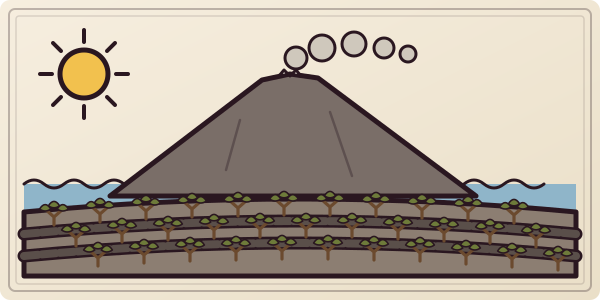
In the east, north of Catania, stands Etna, the tallest active volcano in Europe, over 3,300 meters high and about 45 km across. The vineyards climb the slopes on terraces of lava stone, in soil of ash and volcanic gravel, and the difference between the heat of the day and the cold of the night reaches 20 or 25 °C.
The region's grapes
The DOC Sicilia consortium counts more than 70 native grapes on the island. The signature red is Nero d'Avola, which grows across the whole island and peaks between Siracusa and Agrigento: it makes wine with deep color, full body and aromas of ripe fruit and spices. Among the whites, Grillo, the offspring of a cross between Catarratto and Zibibbo, is strong in the province of Trapani; Catarratto, an old and generous grape, comes in two versions, Comune and Lucido.
On Etna, it's a different crowd. Nerello Mascalese is the main red: it ripens late, in mid-October, and makes a light-colored wine, but with tannin (that grip on your gums), high acidity and a mineral streak. Nerello Cappuccio goes into the blend, and Carricante is the mountain's white. International grapes, like Syrah, Merlot, Chardonnay and Pinot Grigio, also fit into DOC Sicilia.
What wine comes from there
Day to day, Sicily is full-bodied Nero d'Avola red, packed with fruit, and Grillo white, perfumed, smelling of herbs and citrus, with good acidity and a slightly salty taste. Etna gives Nerello Mascalese reds, lighter and more elegant, that recall a mountain red more than a sunny one; Carricante whites, with orange blossom and white fruit; rosés and sparkling wines. And in the west, near Trapani, Marsala is born, a liqueur wine: it gets wine alcohol or wine spirit, like Port wine, and can come out dry, semi-dry or sweet, gold, amber or ruby in color.
What the label says
The Italian ladder applies. IGT (Typical Geographical Indication) is the broadest: Sicily has six, and one of them is Terre Siciliane. DOC (Controlled Designation of Origin) has a zone and rules; Sicily has 23, according to the list from Italy's Ministry of Agriculture. DOCG (Controlled and Guaranteed Designation of Origin) is the top step, with a state seal on the bottle, and the island has only one: Cerasuolo di Vittoria. The names that show up most:
- Sicilia DOC: created on November 22, 2011, it covers almost the whole island, with native grapes, like Nero d'Avola and Grillo, and international ones.
- Terre Siciliane IGT: one of the island's six IGTs, on the broadest step of the label.
- Etna DOC: from 1968, Sicily's first DOC. Etna Rosso and Rosato have at least 80% Nerello Mascalese; Etna Bianco, at least 60% Carricante (80% in Bianco Superiore). Etna Rosso Riserva waits at least four years, one of them in wood. The label can show one of the 133 contrade, the volcano's official localities.
- Marsala DOC: in the province of Trapani. The name tells you the waiting time: Fine (one year), Superiore (two), Superiore Riserva (four), Vergine or Soleras (five) and Vergine Stravecchio or Riserva (ten). Oro and Ambra come from white grapes, like Grillo, Catarratto and Inzolia; red grapes are reserved for Rubino.
- Cerasuolo di Vittoria DOCG: the island's only DOCG, in the southeast.
What it pairs with
Nero d'Avola is a red for a generous table: pizza, pasta, eggplant parmigiana, grilled sausage, ribs. Grillo, fresh and a little salty, goes with grilled fish, shrimp, squid, salad and even moqueca (Brazilian fish stew). The Etna red, with a lighter touch, pairs with seared tuna, mushrooms, roast chicken and pasta al sugo; the Carricante white, with seafood. And sweet Marsala goes with cake, cannoli and aged cheese, while the dry one shines as an aperitif. All suggestions: liked another pairing? Go with that one.
Phoenicians, Greeks and an Englishman named Woodhouse
According to the DOC Sicilia consortium, it was the Phoenicians who brought the cultivated vine to the island and sold Sicilian wine around the Mediterranean, probably sweet, made from overripe grapes. Then came the Greeks, in the 8th century BC, with the alberello, the way of training the vine as a low bush that you can still see on Etna. Julius Caesar liked Mamertino, from the Messina area.
Marsala was born much later, between the 18th and 19th centuries, when the British fleet roamed the Mediterranean and the English merchant John Woodhouse began selling the wine from there across Europe. At the end of the 19th century came phylloxera, the pest that kills the vine's roots. On Etna, the volcanic soil held the pest back, and to this day there are century-old vineyards without grafts, on their own roots.
The grapes in the labels from here
Across the 323 Sicily labels in the search, the grapes that show up most. The number is how many labels use each one.
Top rated from Sicily
Average rating from the people who drank it (X-Wines), from 1 to 5. Tap to see the wine's page.
- Gabrio & Giotto Bini-Serragghia Zibibbo Secco Biancorating ★ 4.5
- Passopisciaro Franchettirating ★ 4.4
- Donnafugata Mille E Una Notterating ★ 4.4
- Tenuta delle Terre Nere Prephylloxera La Vigna di Don Peppino Etna Rossorating ★ 4.3
- Occhipinti Nero d'Avola Sicilia Siccagnorating ★ 4.3
- Pietradolce Vigna Barbagalli Etna Rossorating ★ 4.3
- Occhipinti Il Frappato Siciliarating ★ 4.3
- Cellaro Due Lune Nerello Mascalese-Nero d'Avolarating ★ 4.3
See the Sicily labels in the search →
Spotted something wrong on this page?
Got it, thanks. The house checks the source and fixes it.