The regions · New Zealand
Marlborough: the Sauvignon Blanc from the hole in the cloud
Marlborough sits at the northern tip of New Zealand's South Island and is by far the country's largest wine region: 73% of all New Zealand's vineyards, according to New Zealand Winegrowers. It was Sauvignon Blanc from here that, in the 1980s, put New Zealand on the wine map. In 2025, 84% of the grapes harvested in the country came from there.
Where it is and what the place is like
Marlborough occupies the top of the South Island, at 41.3 degrees south latitude, between the sea and the mountains: Cook Strait to the north and the Pacific Ocean to the east. The ranges shelter it from bad weather, and the sea cools it down. It's one of the sunniest and driest regions in the country: the local association talks about some 2,500 hours of sun and 649 millimeters of rain a year. The Māori called the Wairau valley Kei puta te Wairau, the place of the hole in the cloud.
The trick is in the difference between day and night. In summer, the temperature drops about 11 degrees from day to night. The strong sun ripens the grapes, and the cold night holds on to the acidity and makes the sugar rise slowly. The result is fruit with intense aroma that doesn't lose its freshness. That's why the white from there reaches the glass with so much aroma and so much acidity.
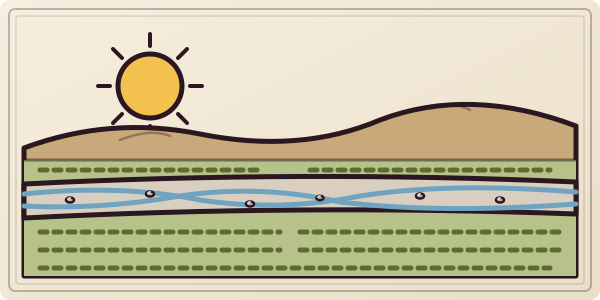
The region has three big pieces. The Wairau valley is the largest and most planted, with gravelly soil from an old riverbed, which drains well. The Southern Valleys, a set of valleys to the south (Brancott, Omaka, Fairhall, Waihopai, Ben Morven and Taylor), have heavier soil, with more clay, and account for about a fifth of the vines. And the Awatere, farther south, is the coldest, driest and windiest corner, at the foot of the region's highest peak, Tapuae-o-Uenuku, at 2,880 meters.
The region's grapes
There's no contest here. In 2025, Sauvignon Blanc covered about 27,000 of Marlborough's 32,000 hectares, more than eight in ten, according to New Zealand Winegrowers' vineyard report. The gap to second place is huge: next come Pinot Noir, with about 2,200 hectares, and Pinot Gris and Chardonnay, with a little over a thousand hectares each. Riesling, Gewürztraminer and Grüner Veltliner show up in small areas.
Pinot Noir is the local red. It likes the slopes of the Southern Valleys, where the soil is poorer, and makes reds of dark cherry, plum and a touch of spice. It also goes into the sparkling wines made by the traditional method (the Champagne one, with the second fermentation inside the bottle) and into the region's rosés, fresh and fruity.
What wine comes from there
Marlborough Sauvignon Blanc has a character all its own: it brings to mind gooseberry, lime zest, green apple and bell pepper, and arrives with very lively acidity, kept by the cold nights. Most of it ferments cold in stainless steel tanks, precisely to keep that freshness and perfume. Some producers use barrels and leave the wine in contact with the lees (the deposit of yeasts), which gives more texture and body. Beyond that, the region turns out Pinot Noir, sparkling wines, rosés and whites from Pinot Gris, Chardonnay and Riesling.
What the label says
Marlborough is a registered geographical indication (GI, the protected name of a place). The registration, number 1004, went into New Zealand's official register in February 2018, effective from July 2017, under the 2006 geographical indications act for wines and spirits, which only came into force in 2017. The registration was requested by the Marlborough grape growers' association.
In New Zealand the 85% rule applies: if the label names a grape, a vintage or a place, at least 85% of the wine is that. A 2008 Marlborough Pinot Noir, in New Zealand Winegrowers' own example, has at least 85% Pinot Noir from Marlborough harvested in 2008. With more than one grape on the label, they come in order, from the one with the most to the one with the least. Since 2018 the local association also has a registered trademark, Appellation Marlborough Wine, created first for Sauvignon Blanc.
What it pairs with
Marlborough Sauvignon Blanc and seafood get along: casquinha de siri (stuffed crab shells), garlic-and-oil shrimp, moqueca, grilled fish with lime. It also goes well with salads, tomatoes, bell peppers and vinegar-based sauces, and makes an aperitif on a sunny day. Pinot Noir goes with salmon, roast chicken, duck, pork loin and even lamb. Pairing is a suggestion: liked another pairing? Go with that one.
A century of waiting
In 1873, the Scotsman David Herd planted a small vineyard of moscatel grapes in the southern valleys. For almost a hundred years, though, Marlborough was really known for barley, alfalfa and sunshine. The turning point came in August 1973, when an Auckland wine company began planting commercial vineyards in the Brancott valley. Two years later, in 1975, the first Sauvignon Blanc arrived. At the time, almost nobody took seriously the idea that famous wine would come from there.
In 1984 phylloxera appeared (a pest that attacks the vine's roots), and by 1992 it had spread. Even so, the area kept growing: 2,655 hectares in 1997 and over 21,000 in 2007. Today the region accounts for about 80% of the wine New Zealand exports, and 97% of its producing area is certified by Sustainable Winegrowing New Zealand, the New Zealand wine industry's sustainability program.
The grapes in the labels from here
Across the 238 Marlborough labels in the search, the grapes that show up most. The number is how many labels use each one.
Top rated from Marlborough
Average rating from the people who drank it (X-Wines), from 1 to 5. Tap to see the wine's page.
- Taka Sauvignon Blancrating ★ 4.4
- Rapaura Springs Reserve Marlborough Sauvignon Blancrating ★ 4.4
- Barker's Marque Wines Three Brooms Single Vineyard Sauvignon Blancrating ★ 4.3
- Caroline Bay Sauvignon Blancrating ★ 4.3
- Maori Moana Sauvignon Blancrating ★ 4.3
- Insight Sauvignon Blancrating ★ 4.3
- Marlborough Sun Sauvignon Blancrating ★ 4.3
- Johnson Estate Sauvignon Blancrating ★ 4.3
See the Marlborough labels in the search →
Spotted something wrong on this page?
Got it, thanks. The house checks the source and fixes it.